
What happens
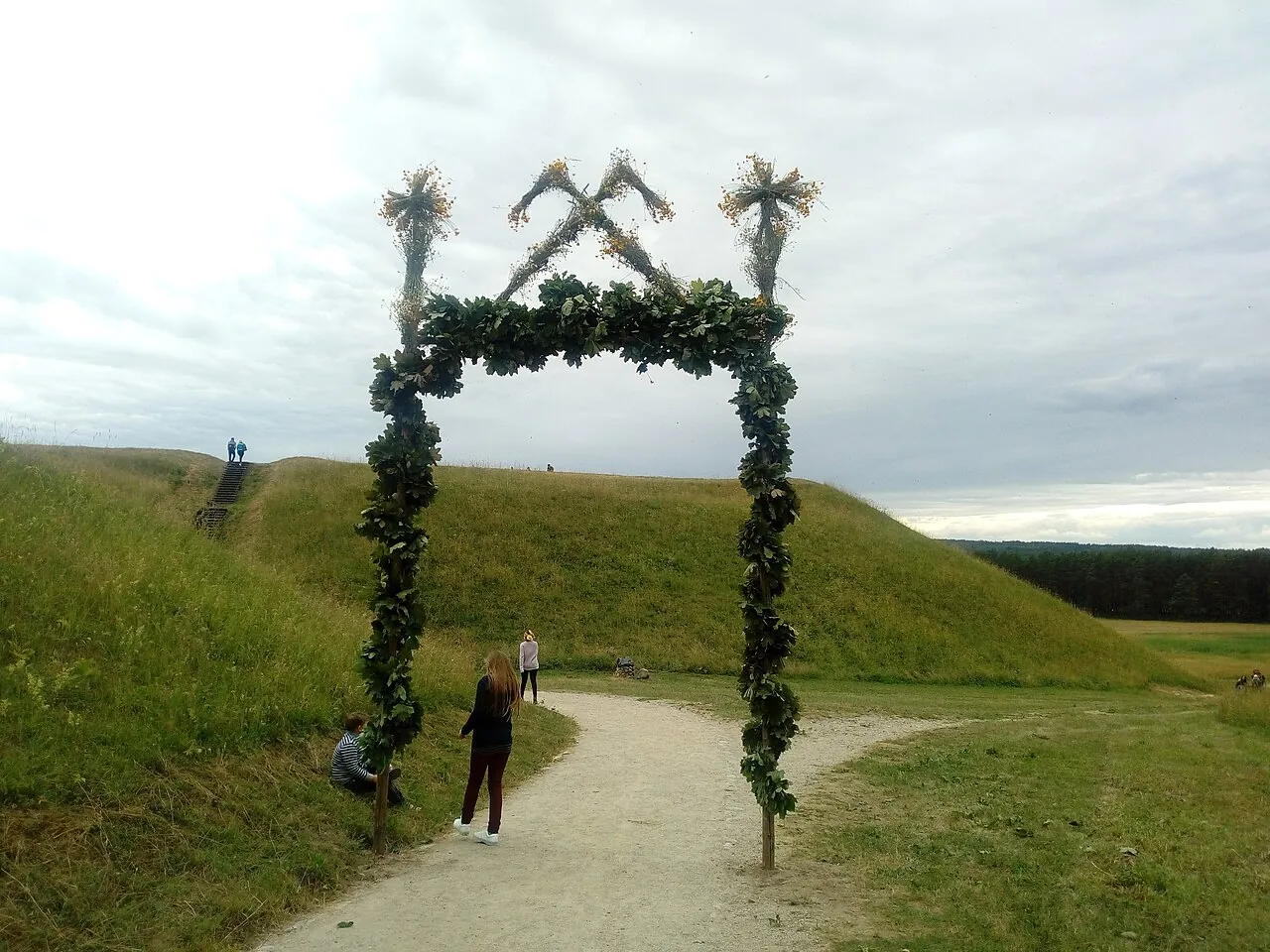
The programme progresses through several kinds of action and several places. Herb gathering and wreath-making lead towards a procession and ritual gates, followed by sunset observance, an altar ceremony, a large bonfire, night dancing and wreath-floating on the river. The verified 2026 sequence continued to a sunrise and dew observance in the early morning.
Those changes of place are essential to understanding the visit. Kernavė’s avenue, the Pajauta valley, Pilies and Aukuras hills and the Neris are not one level performance enclosure. Decide what you want to see and allow time to move with the public flow. You do not need to follow every stage to appreciate the celebration. Leave ceremonial working space clear, particularly near water and fire, and accept that a good position for one part may not suit the next.
A modern revival with older sources
The State Cultural Reserve describes the revival beginning in 1967, based on historical, ethnographic and folklore material. That gives the contemporary gathering a particular place in Lithuanian cultural life, while acknowledging that the programme has been consciously researched and renewed. It is more precise than presenting every action as an uninterrupted survival from a single ancient date.
The landscape helps carry that interpretation. Hills, valley, river and the turn from sunset to dawn supply a setting that changes as the evening develops. Listen to the folklore groups and notice how songs and movement link the separate rites. The value of the visit is not confined to the biggest fire or a photograph of a wreath. A quieter early gathering can make the later public sequence easier to understand, especially for a first-time visitor unfamiliar with the language.
The 23–24 June 2026 sequence
The official 2026 programme names 23 June and continues through midnight to a 4:30 sunrise/dew appointment, supporting the two-calendar-day span recorded here. Historical times included herb gathering at 17:00, wreath-making at 19:00, the procession at 19:45 and wreath-floating at midnight. They explain that edition, not a booking schedule for 2027.
Ask for a fresh dated programme before planning another visit. A midsummer association does not settle the precise route, weather arrangements or duration in a later year. The historical programme includes fire-jumping, but this guide does not recommend visitors attempt it or interpret its presence as an unsupervised participation invitation. Separate watching a documented rite from choosing a personal activity. The practical question is which public parts are offered, where they take place and how you will move between them.
Can I take part?
The reserve’s invitation welcomes visitors into the celebration with folklore groups, so this is not described as a closed private ceremony. Wreath-making, singing or following the procession may offer ways to engage, subject to the hosts’ actual arrangements. Ask about a particular workshop, materials, language or group place if joining it is important to your trip.
No current ticket price, guaranteed workshop space or all-night supervised children’s programme was established. Do not assume a general public invitation means every ritual action is suitable or open to a newcomer. Observing from an appropriate position remains meaningful participation in the public occasion. Follow the reserve’s directions around archaeological ground, fire and the river rather than inventing a parallel celebration nearby. There is no need to complete the entire night or join a hazardous-looking action to count the visit worthwhile.
Where to stay and how to leave
Kernavė is the useful base for a night-long visit if you can secure an appropriate room. The reserve’s visitor pages identify Šulinys studio-gallery at Vilniaus 8 and Jorunas at Pilkapio 15, with lodging or camping by arrangement. Enquire about the actual accommodation, arrival and booking conditions rather than treating a cultural listing as live availability.
Vilnius is an alternative only when the late return has been organised. A normal daytime bus table does not prove transport after midnight or dawn. If a driver is collecting you, agree the public collection place and an attainable time before entering the evening programme. For camping, obtain permission and facilities information rather than assuming the archaeological reserve is an open campsite. Choosing an early departure is also reasonable; plan the selected ceremony and return together instead of leaving transport to the end of a long night.
Practical bits
Getting there from the UK
Vilnius is the sensible gateway to compare for flights from the UK. The airport publishes a railway connection to Vilnius station, with an indicative journey of up to eight minutes and a separate short approach from the terminal to the airport stop. Check its operating hours and current LTGLink notices for the actual arrival.
The reserve gives bus approaches from Vilnius towards Širvintos via Kernavė and road directions using the relevant regional roads. Use those as the basis of a real journey search, including the final stop and walk. An airport train only solves the city transfer; it does not take you to the hillforts. Arriving before the evening also leaves room to locate accommodation, visit an exhibition and learn the terrain in daylight rather than finding the valley for the first time after sunset.
Access and families
The celebration moves across a historic landscape with hills and changing surfaces. No continuous step-free route or accessible viewing arrangement for the full sequence was verified. Ask the reserve which parts can be reached from a suitable drop-off, whether firm paths remain open and where toilets and seating are available.
Families can choose the wreath-making or an earlier procession stage without committing to dawn. Explain the movement between places and keep a clear meeting plan if the crowd grows. Children’s ability to attend a public gathering does not establish permission to approach a fire or enter the river. Take the programme as several choices rather than a challenge to finish every item. A short, well-planned observation in the right setting may be more enjoyable than carrying on when the group is tired and the return has become uncertain.
Plan your trip
Stay the night
We earn a commission if you book through these links, at no extra cost to you.
Search places to stay in and around Kernavė. For Rasos in Kernavė, add your own stay dates to this undated search.
Find a place to stay on Booking.com (affiliate link)Plan your journey
Vilnius is the natural air gateway. The airport has train and bus links into the city; the reserve names buses towards Širvintos via Kernavė and road approaches. Ordinary daytime services do not solve the return after a night-long programme.
Booking.com links are affiliate links. What that means.
Where it is
Kernavė town-area marker; the ceremony sites and their visitor entrances are not pinpointed.
The map pin for Rasos in Kernavė marks an approximate area. Open in OpenStreetMap
Stay on: the day before and after
The reserve museum at Kerniaus 4 A interprets the archaeological site and the work that has revealed its past. Its open-air reconstruction contains craft homesteads based on excavations, rather than intact houses surviving from the Middle Ages. That distinction helps make the landscape meaningful before the evening customs begin.
Check indoor exhibition hours separately. In 2026, the published holiday table gave specific 23 June hours and a 24 June closure; it did not promise an all-night museum refuge. The reserve also lists galleries and a White Mountain trail as separate visitor options. Choose an appropriate walk with time and daylight to spare, rather than adding a full excursion to an already long ceremonial night. Staying locally lets archaeological interpretation, a modest daytime exploration and Rasos complement one another without overloading a single evening.
Odd things nearby
- Kaziukas Fair in Vilnius 22 miles away, 5–7 March 2027 — confirmed by Go Vilnius; detailed programme to follow
- Riga Bluķa log-dragging ritual 145 miles away, 21 December 2026
- Jāņi in Riga 145 miles away, Expected 23–24 June 2027; Riga public programme not yet announced
Also in June
- Lajkonik Kraków Kraków, Poland
- Nestinarstvo in Bulgari Bulgari, Tsarevo municipality, Bulgaria
- Kazanlak Rose Festival Kazanlak, Bulgaria
- Amarante’s São Gonçalo Festival Amarante, Portugal
About this guide
For Rasos in Kernavė, check before you go. Historical 2026 programme only; no future date is inferred. Documented fire-jumping is context, not visitor advice.
About the date. Last held 24 June 2026; next date not announced yet. For Rasos in Kernavė, check the organiser before travelling.
For Rasos in Kernavė, researched from the sources below and last checked on . For Rasos in Kernavė, we haven’t visited every event or tested every journey, and the organiser’s own information always wins.
For Rasos in Kernavė, previous date evidence. The reserve programme runs from 23 June 2026 into 24 June dawn. It dates the modern revival to 1967.
- State Cultural Reserve of Kernavė
- State Cultural Reserve of Kernavė
- State Cultural Reserve of Kernavė
- State Cultural Reserve of Kernavė
- State Cultural Reserve of Kernavė
- State Cultural Reserve of Kernavė
- Vilnius Airport rail
Have we got something wrong about Rasos in Kernavė? Report an issue with Rasos in Kernavė.