What happens
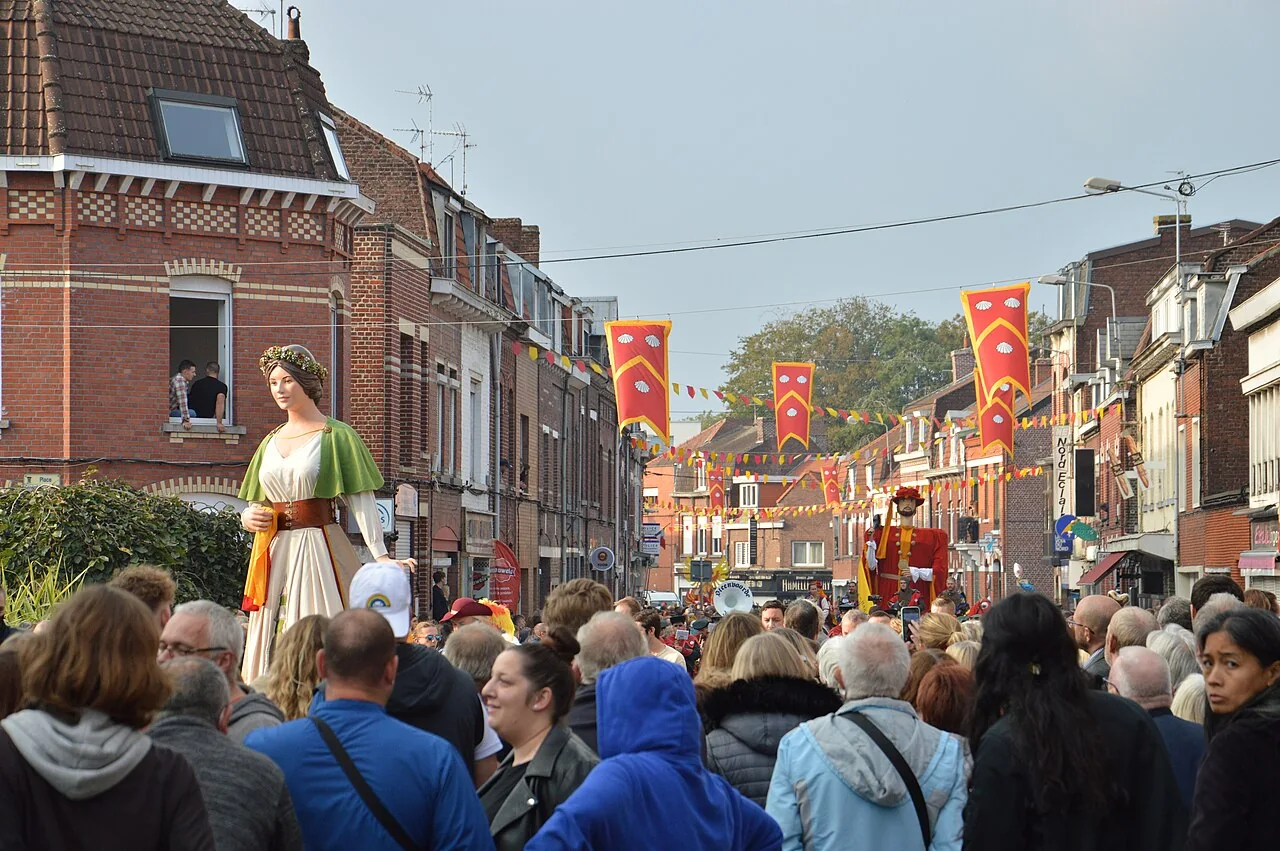
Wooden ladles fly from Comines’s town hall towards the gathering below, following a historical procession that brings local stories and carried giants into the streets. The striking combination of ordinary household objects and civic theatre is the reason to visit. A clear view can be as rewarding as trying to catch a ladle.
The verified 142nd edition ran on 10–12 October 2026, with Arthur, enfant des Louches as its theme. No next edition date is confirmed. The council describes the normal second-October-weekend period, but that custom is not used here to calculate a future booking date. This guide selects the ladle tradition and its historical procession within the larger programme.
The prisoner’s spoon and other explanations
The best-known story tells of a captive lord who threw a spoon bearing his family’s arms from a tower. Its discovery revealed where he was held and led to his rescue. The council presents that account explicitly as a local legend, rather than an established eyewitness history.
It also records alternative explanations involving ransom payments, the privilege of a trading fair and traders throwing spoons to attract people. The current organising committee dates from 1884. Keeping those layers separate makes the custom more interesting: a vivid rescue story coexists with the town’s commercial history and a modern committee that sustains the celebration.
Giants and a cross-border procession
For 2026, the Sunday historical procession began at Comines railway station in Belgium and finished at Grand Place in France. That is an important practical distinction as well as an expression of the shared townscape across the Lys. A station pin and a town-hall pin can put you on different sides of the border.
The procession includes tableaux and giants connected with local history and identity. The organiser’s 2026 theme used Arthur to transmit those stories to another generation. Costumes and figures should be read in that local context rather than treated as a generic carnival parade. Mounted elements or other attractions in the wider festivities are separate from the selected human custom.
Can I take part?
Visitors can watch the procession and ladle throw, but a place in a costumed group is not assumed. The committee’s practical notice acknowledges that catching ladles can become rough and asks for courteous behaviour. Choose whether you want to stand in the catching area or observe from a position that better suits your party.
The 2026 Saturday children’s throw used a controlled area for children between 1.05 and 1.40 metres tall. That precise past condition should not be turned into a promise for another edition. Ask about the new programme’s arrangements before telling a child they can join. No future admission price or visitor-group registration rule has been verified.
Planning the important moments
The 2026 Sunday procession was scheduled from 3pm, with the traditional ladle throw around 5.30pm. These are historical timings that show why the Sunday afternoon deserves its own plan. Saturday’s lantern procession and children’s throw were separate events, while Monday retained the trading-fair element.
Use the next official route, street orders and public instructions when they are issued. The committee’s practical page contains some mixed-year text, so check that a road-closure document really belongs to your edition. A restaurant reservation can be useful, but it should leave time to reach your viewing place without pushing through the gathering. The event does not guarantee that everyone catches an object.
Where to stay
Comines itself can suit a visit focused on more than one part of the celebration. The French council’s accommodation page lists gîtes and chambres d’hôtes in the surrounding area. Establish which side of the border and how far from the centre the property actually lies; a rural address may require a vehicle after the evening events.
Lille is an alternative base for its international rail connection, provided you have checked the final journey back from Comines. Compare the convenience of a local overnight stay with the additional transfer before choosing. Ask about arrival during road closures, luggage and minimum stays. Neither the municipal directory nor a festival reference confirms live room availability or an event package.
Practical bits
Getting there from the UK
Eurostar provides the direct London–Lille connection, arriving at Lille Europe. From Lille, consult ilévia’s dated journey planner for Comines or arrange a road transfer. The network has been revised, so an older L90 timetable should not be treated as proof of the next festival weekend’s route or frequency.
Check whether your chosen destination is Comines mairie in France or a Belgian address. The former procession’s departure at Comines Belgium station does not mean a train from Lille arrives beside the ladle throw. Verify the complete outward and return journeys, including any final walk across the river. Keep the international train’s station-arrival requirements in mind if returning to the UK that evening.
Access and families
The children’s throw and the main public catch have different conditions. A family should not assume that a small child belongs in the densest part of the Sunday gathering because a separate children’s event exists. Choose a view of the procession and town hall that allows a comfortable exit.
No next-edition accessible viewing area, reserved seating or adapted toilet location has been verified. Contact the committee about a particular approach and the space you need. The ilévia app offers an accessible-itinerary filter for equipped stops, but street barriers and the gathering require a separate check. Watching from farther back is a valid way to enjoy the ritual without competing for a ladle.
Plan your trip
Stay the night
We earn a commission if you book through these links, at no extra cost to you.
Search places to stay in and around Comines, or Lille with checked onward transport. Wait for Fête des Louches’s next date before adding dates to this search.
Find a place to stay on Booking.com (affiliate link)Plan the journey to Comines
Eurostar reaches Lille Europe from London. Continue using the current ilévia journey planner or an arranged road transfer to Comines; distinguish the French town-hall destination from Comines station in Belgium, which was the 2026 procession starting point.
Booking.com links are affiliate links. What that means.
Where it is
Approximate town/area marker for Comines. Not a verified event entrance, viewing place or complete course.
The map pin for Fête des Louches marks an approximate area. Open in OpenStreetMap
Stay on: the day before and after
On the day before, use the council’s Grand Place discovery walk to understand the town hall, belfry and Saint-Chrysole church. Their reconstructed townscape helps explain why the square is such a strong stage for the custom. Check interior opening separately; the walk does not guarantee access to every building.
The day after, explore the ribbon-making history across the river at the Musée de la Rubanerie cominoise when its schedule permits. The Belgian tourist office publishes seasonal guided-visit hours, with ordinary Monday closure, so move that visit to another day if necessary. Its looms and textile heritage supply a useful counterpart to the people and stories represented by the local giants.
Odd things nearby
- Kattenstoet Cat Parade 8 miles away, 9 May 2027
- Braderie de Lille 9 miles away, 4–5 September 2027
- Fêtes de Gayant in Douai 28 miles away, 11 July 2027
Also in October
- Concurs de Castells Tarragona, Spain
- Leidens Ontzet Leiden, Netherlands
- Los Tableros de Valdefuentes Valdefuentes, Cáceres, Extremadura, Spain
- Zaragoza Giants and Big-Heads Zaragoza, Spain
About this guide
For Fête des Louches, check before you go. 2026 timing, route, theme and children’s height range are historical. No next date projected. Scope is human procession and ladle ritual; wider market/fair and any animal-related programme are separate. Committee practical page includes some mixed-year road text, requiring edition checks.
About the date. The 142nd historical festival ran on 10–12 October 2026, themed Arthur. The Sunday procession started at Comines station in Belgium and finished at Grand Place in France; wooden ladles were thrown from the French town hall. Saturday had a separate children’s throw in a secured area for children 1.05–1.40m tall. These are 2026 details, not next-edition promises. The council distinguishes the prisoner’s spoon legend from alternative historical explanations involving ransom payments and a trading fair; the committee dates from 1884. The normal period is the second October weekend. Spectators can watch; participation in costumed groups is not assumed. Accessible viewing and next-edition admission arrangements are unverified.
For Fête des Louches, researched from the sources below and last checked on . For Fête des Louches, we haven’t visited every event or tested every journey, and the organiser’s own information always wins.
- Official 2026 programme and children’s conditions
- Canonical council context
- Council folklore: legend and historical alternatives
- Committee origins account
- Committee visitor and crowd guidance
- Council local accommodation
- Grand Place discovery walk
- Ribbon museum: seasonal visiting arrangements
- Eurostar routes to Lille
- ilévia dated journeys and accessible filter
Have we got something wrong about Fête des Louches? Report an issue with Fête des Louches.